Information can be expressed through verbal (description) and non verbal (diagrams) modes. Some of the non-verbal modes are :
Pie-charts,
Bar graphs,
Tree diagrams,
Flow charts and
Tables.
The process of changing a text from Verbal to Non-verbal mode or vice versa is called Information Transfer. This is a very useful and important skill for students. Acquiring this skill enables the students make notes quickly, understand various texts effectively and present ideas clearly and briefly.
Non-verbal expressions are remarkable for their brevity, clarity, simplicity, accessibility and provision for comparative, contrastive and analytical studies.
1. PIE-CHARTS
A pie-chart is a circle divided into parts. Each part represents a particular thing. And eah part is in proportion to the ratio of that thing to its total. Studying the given pie chart slowly helps one understand the information given there. Then the information can be presented in verbal mode. Once the mode of representing the given information in the form of a pie-chart is understood, verbal text can be transferred into a pie-chart.
In a pie charl; the information is presented in the form of a circle. The circle is divided into sections called sectors. The contribution of each unit in the chart is represented in percentages.
Example 1 : The following pie chart depicts the results of a survey regarding distribution of different Blood Groups in a college. Blood Groups in a College
From the figure we can see that 35% of the students of a college have 0 Group of Blood and these students form the largest group. The next largest group comprises students with B Group of Blood. 30% of students belong to this category. 25% of students have AB Group of Blood. Finally, we see that only 10% of students have A Group of Blood. Thus, from the piechart we can conclude that while many students have O Group of Blood. Very few have A Group.
Example 2 : The following piechart depicts the favourite subject of students in a class. We can see from the figure that five subjects have been taken into consideration – Economics, Civics, Commerce, English and 2nd Language. Students who like Economics form the largest group. A quarter of the students of the class i.e 25% expressed preference for this subject. 20% of the students like English and the same percentage i.e 20% of the students like Commerce. Next in popularity is Civics, liked by 18% of the class. Finally, trailing closely behind Civics, comes 2nd Language, which is the favourite subject of 17% of the students. Favourite Subjects of Students
Exercises and Activities
Question 1.
The following paragraph gives the information about the most widely spoken languages in India. Convert the passage into a pie chart.
Hindi is the most widely spoken language in India. The fact that 44% of Indians speak Hindi across India justifies its title as our National Language. 9% of Indians speak Bengali followed by Marathi which is spoken by 8%. Telugu comes next in the list with 7%, Tamil and Gujarati account for 6% and 5% respectively. All other languages together share the remaining percentage.
Answer:
Pie chart showing languages spoken in India
Hindi – 44% Bengali – 9% Marathi – 8% Telugu – 7% Tamil – 6% Gujarathi – 5% All other languages – 21%
Question 2.
Read the following paragraph and convert the information into a pie chart.
There are seven continents in the world. Asia is the largest continent with an area of 30% followed by Antarctica with 28%. North America occupies 17% of the land on the earth. South America stands fourth in the list with 12% of land. Africa and Australia are the fifth and sixth largest ones with their respective shares of 6% and 5%. Europe is the last in the list which occupies 2% of the land only.
Answer:
Areas of Continents
Continents Asia – 30% Antarctica – 28% North America – 17% South America – 12% Africa – 6% Australia – 5% Europe – 2%
Question 3.
Observe the pie chart given below. It contains information about the mode of transport used by students of a certain junior college. Write a small paragraph. Mode of Transport of Students
Answer:
Mode of Transport of Students The given pie chart presents the mode of transport used by students of a particular junior college. A major part of them 40% – use the public transport, i.e. bus. A half of the share of bus, that is 20% of them travel by autorickshaws. Two wheelers and cars carry 15% each of the students. Just 10% of them use the cleanest and the healthiest mode – walking.
Question 4.
The pie chart given below shows how people spend their time on smart phones. Convert the information into a paragraph. Time spent on Smart. Phones
Answer:
Time spent on Smart Phones Time spent on smart phones is presented in the given pie chart. The lion’s share, i.e. 35% of the time goes to games. Social networking follows games with its share of 29% of the time. Utilities Consume 20% time. The share of music and videos is 8%. Others take 5% time. News comes last with just 3% time.
2. BAR BRAPHS
A bar graph is a diagram in which values of variables are shown by the length of rectangular columns with equal width. It is another visual representation of data. It helps to compare the values presented in a group. The bars can be plotted vertically or horizontally. A vertical bar chart is sometimes called a column bar chart.
Example 1 : Given below is the iar graph that shows the cost of certain vegetables over a period of 4 months. Let us now make a detailed analysis.
The bar graph given below shows the cost of carrots and potatoes over a period of four months – January, February, March and April. Carrots were more costly than potatoes during all the months. In January carrots cost Rs. 35 a kilo, while potatoes cost a little less, at Rs. 30 a kilo. The cost of carrots increased to Rs. 40 in February, while there was a sharp fall in the cost of potatoes.
There was a sharp rise in the cost of both the vegetables after that and in March the cost of carrots was Rs. 50 per kilo while that of potatoes was Rs. 40. In April once again there was a steep increase in the cost of carrots but the cost of potatoes remained the same as in March. Thus we observe that the cost of carrots kept increasing over the months but that of potatoes fluctuating. COST OF VEGETABLES (in Rs per kg)
Example 2 : The following bar graph represents the favourite sports of various group of students studying in a college. Students of four sections HEC, CEC, BPC and MPC were asked about their preferences in sports. The number of students in each section varied. Three sports were considered – football, cricket and kabaddi. HEC students expressed great interest in cricket. 50 out of 85 students, i.e. more than half liked cricket. Very few in that section, just 5, were fond , of football. 30 liked kabaddi.
In the CEC section, consisting of 100 students, an equal number of students, i.e. 40 liked kabaddi and cricket. 20 liked football. With regard to the science sections, cricket was more popular among BPC students. An equal number in both the sections, 30, were fond of football. The figures for kabaddi too were more or less the same. The BPC section consisted of 88 students while MPC students were 75 in number. On the whole, one can conclude that cricket is the most popular sport in the college, followed by kabaddi. FAVOURITE SPORTS OF STUDENTS
Exercises And Activities
Question 1.
The passage below represents the data of improvement of English language skills due to Internet usage. Present it in a bar graph.
Internet plays an important role in improving Reading skills. 94% participants in this study agreed that they improved their Reading skills by using Internet while 91% opined that they improved Translation skills. Internet usage helped 87% of participants in enhancing their vocabulary skills. 80% of participants unanimously agreed that they improved their Writing skills, Speaking skills and Grammar.
Answer:
Bar Graph Showing Skills due to Internet Usage
The following passage shows the favourite sports of the students of a school. Represent the data in a bar graph.
Question 2.
Cricket is the most favourite sport of the students which is liked by 80 students. Tennis falls behind Cricket with a slight difference. It is the favourite of 75 students. Swimming and Football are liked by 40 and 45 students respectively while Badminton is the favourite of 30 students. Hockey is the least favouring sport of the students which is liked by 20 students only.
Answer:
Bar Graph Showing Favourite Sport of Students
Question 3.
Analyse the bar graph given below and write about it in a paragraph. MARKS OF STUDENTS?
Answer:
The bar chart presents marks of three students in three subjects. Meena scored 70 in Telugu, 65 in Maths and in English just 50. Mala scored 65 in Maths, 50 in Telugu and only 40 in English. Megha secured 70 each in English and Maths but scored 60 in Telugu.
Question 4.
The given below bar graph shows how much dietary fibre is found in certain fruits. Convert the information into a paragraph?
Answer:
Fibre Content in Fruits The given bar graph presents the details of fibre content in various fruits. The guava stands tall with six (6) grams of dietary fibre per a serving of one cup. Next comes the pear with five (5) grams per unit. The third in the order is the apple with four (4) grams per a cup. The banana and the orange have almost the same quantity of dietary fibre – three (3) grams per cup.
3. TREE DIAGRAMS
A tree diagram is another way of representing information. It has a branching tree-like structure. It shows how its components are related to one another. It helps us understand the relevant information in a short time.
Example 1 : There are three types of muscle in the human body. They are smooth, cardiac and skeletal muscles. Smooth muscles are controlled by involuntary responses. Examples of smooth muscles are muscles in the digestive tract and blood vessels. The second type of muscle is cardiac muscle. It is also an involuntary muscle. Muscles that cover the heart are examples of cardiac muscles. The third type of muscle is the skeletal muscle. It is controlled by voluntary response. All the muscles attached to the bones such as biceps, deltoid are examples of skeletal muscles.
The above paragraph can be depicted in the form of a tree diagram as follows.
Example 2 : A man who managed a popular hotel was asked the secret of his success. He said that only when customers were happy with the dining experience would they keep returning to the hotel. Dining would be a pleasant experience only if the food served was of a high standard. Good service too was equally important. He elaborated that food should be tasty and fresh. Service should be prompt and courteous. Given below is a tree diagram representing the man’s views.
Exercises And Activities
Question 1.
Read the following paragraph and transfer the information into a tree diagram?
The oldest musical instrument in the world is the drum, made initially in one of the three ways. First, frame drums were made by stretching the skin over bowl-shaped frames. Next, rattle drums were made by filling gourds or skins with dried grains, shells, or rocks. Finally, tubular drums were made from hollowed logs or bones covered with skins. Both frame and tubular drums were struck with the hand or with beaters to produce sounds. In contrast, rattle drums were shaken or scraped to make rhythmic sounds. For thousands of years, drums have been used to transmit messages to call soldiers to battle and make music.
Answer:
Tree Diagram showing Types of Drums
Question 2.
Read the following paragraph and transfer the information into a tree diagram?
There are so many species of animals that we find living on the earth. Scientists grouped these animals into different classes based on certain similarities they share. Animals are divided into vertebrates, ones with backbones and invertebrates, those without backbones. The vertebrates are basically divided into five classes. They are commonly known as mammals, birds, fish, reptiles and amphibians. Arachnids and insects are the two commonly known classes in the invertebrates group.
Answer:
Tree Diagram showing Species of Animals
Question 3.
The following tree diagram depicts the classification of Vitamins. Present the information in a paragraph?
Answer:
Classification of Vitamins The given tree diagram presents the classification of vitamins. Vitamins are broadly of two types. They are : 1) Soluble vitamins in water and 2) Soluble in fats. Vitamin B and Vitamin C fall in the category of ‘Soluble in water’. Vitamins A, D, E and K (four) belong to the group of vitamins soluble in fat and Vitamin B is sub-divided into Bl, B2, B3, B6 and B12 (five) types.
Question 4.
Study the following tree diagram and write it in a paragraph?
Answer:
Types of Oils The given tree diagram explains the types of oils. Based on the source, oils are of three categories. They are : 1) Oils from nuts, 2) Oils from vegetation (plants / flowers) and 3) Oils from minerals. Examples are 1) groundnut oil, 2) oils from flowers and 3) oils from the crust of the earth. Groundnut oil is used in cooking. Oils from flowers go into the making of soap, medicines and perfumes (scents). Mineral oil fuels machines and automobiles.
4. FLOW CHARTS
We draw flow charts when we present information in the form of a process. For instance, we construct flow charts to put the information of the industrial production from raw product to finished product in a logical order in successive steps. Flow charts are simple to construct and easy to understand. Each step in the sequence is written in a diagram shape. These successive stages or steps are linked by connecting directional arrows. They guide readers to understand flow charts logically and follow the process from beginning to end. In these flow charts we find elongated circles, rectangles and diamond shaped diagrams.
Example 1 : Describe how the following passage is presented in a flow chart. The passage shows the time table for children in a boarding school. You are supposed to wake up at 5 am every day and lights – out time is 9.30 pm. Siesta time is between 1 and 2 in the afternoon. Assembly begins at 8 am sharp in the school hall. You have to report to your House Prefect by 7.30 am on all school days. You may play any game between 4 and 6 pm. You must not be late for study time which is between 6 and 8 in the evening. School timings are from 8.30 am to 3.30 pm with an hour-long lunch break at 1 pm. These details are shown in a flow chart.
Time table of children in a boarding school
Example 2 : Read the following paragraph and transfer the information into a flow chart.
Rayon is a man-made fiber. It is a reconstituted natural fiber – cellulose. Rayon is made by dissolving cellulose in a solution of sodium hydroxide or caustic soda. The cellulose is obtained from shredded wood pulp. The dissolved cellulose is formed into threads by forcing it through a spinneret in a dilute sulphuric acid setting bath. The threads are drawn from the setting bath, wound on a reel, washed, dried on a heated roller, and finally wound onto a bobbin.
Process of Making Rayon
Exercises And Activities
Question 1.
The following paragraph describes how clothes are washed?
Draw a flow chart based on the information given. First, fill a bucket half full with water. Then, add a spoonful of washing powder. Stir vigorously till the power mixes with water and forms foam. Put the unwashed clothes into it. Wait for fifteen minutes. Take out clothes and scrub with a brush to remove stains. Now, rinse the clothes with clean water.
Wring out the clothes gently by twisting and compressing them. This removes excess water from the clothes. This saves the time of drying. Now dry the washed clothes by putting them on the clothes line. Collect the washed and dried clothes later.
Answer:
How to wash clothes
Question 2.
Convert the following paragraph into a flow chart?
Silver occurs in the ores of several metals. The frothing process of extracting silver accounts for about 75% of all silver recovered. Here the ore is ground to a powder, placed in large vats containing a water suspension of frothing agents, and thoroughly agitated by air jets. Depending on the agents used, either the silver-bearing ore or the gangue adhering to the bubbles of the foam is skimmed off and washed. The final refining is done using electrolysis.
Answer:
Flow Chart depicting Frothing Process of Extracting Silver
Question 3.
The following flow chart describes how paper is manufactured in a paper mill. Write the details in a paragraph. Manufacture of paper?
Answer:
The given flow chart describes the process of manufacturing paper. First, the raw materials like wood, grass, bamboo and rags are procured. Secondly they are cut into pieces, immersed in water and made into pulp. Then the pulp is mixed with lime for whitening. Later, the pulp is boiled and passed through wire meshes. At this stage, we obtain wet paper. Finally, it is passed over heated rollers. Then we get the end product, in the form of thin sheets of paper.
Question 4.
Draw a flow chart based on the information given below?
The following process is the description of how a post office transfers a letter from a sender to a receiver. First, the sender posts the letter in a post box. Next, the box is opened. Then the contents in it are sorted out. Then they are kept in a bag and the bag is tied. The destination is written on the bag. The bags are sent to the district post office. The district post office sends the bags to the destination village / town post offices. The destination post office receives the letters. The received letters are arranged and sorted out. The post man delivers the letters to the addressees.
Answer:
Flow Chart depicting the Process of Delivering Letters
5. TABLES
We can also represent information in the form of a table. Example 1 : Given below are the marks secured by Aravind, Akash and Ramesh in their half-yearly examinations of class X.
Name of the Subject
Aravind
Akash
Ramesh
Telugu
81
80
81
Hindi
97
97
97
English
60
88
99
Mathematics
99
97
100
Science
68
91
98
Social Studies
95
98
93
After reading the information given in the table we can write a paragraph like this.
In this table, the marks secured by 3 students are compared. While all the three students scored equal marks in Hindi, there is a slight variation of marks in Mathematics and Social Studies. However, there is a great variation of marks in English. From the table it can be concluded that Aravind needs to concentrate more on English and Science, whereas Akash needs to focus on Telugu and English. Ramesh, who scored the highest marks among the three, needs to focus on Telugu.
Example 2 : The following table shows the number of gold medals won by 8 participating countries in the XII South Asian games 2016. First read the data given in the table.
Rank
Nation
No. of gold medals won
1
India
188
2
Sri Lanka
25
3
Pakistan
12
4
Afghanistan
7
5
Bangladesh
4
6
Nepal
3
7
Maldives
0
8
Bhutan
0
Now read the paragraph given below.
The above table gives the information of the number of gold medals won by 8 participating countries in the XII South Asian games 2016. India secured the first rank with 188 gold metals. It was far ahead of the other countries. Sri Lanka was ranked 2, securing only 25 gold medals. Pakistan got only 12 gold medals and was ranked 3. With 7 golds, Afghanistan is in the 4th place. Bangladesh won 4 golds while Nepal secured just 3 golds. Maldives and Bhutan which stood at the bottom of the table got no gold medals. This table shows the commendable performance of India in the XII South Asian Games.
Exercises And Activities
Question 1.
Read the following paragraph and transfer the information into a table?
A reading test assesses reading comprehension by employing multiple testing techniques, represented by eight main types of questions. Question types, such as Multiple-Choice, Matching, Diagram Labelling, Summary Completion, Sentence Completion, Short Answer Questions with percentage, i.e., 37.50%, 18.13%, 16.25%, 10%, 9.36%, and 8.76%, take place respectively. The number of questions for each of these questions types is variable. Basic English grammar, cloze summary, percentages are although with lower portions and are also considered in the reading test.
Answer:
Table Showing Types of Questions in Reading & Tests
S.No.
Type of Questions
Percentage
1.
Multiple-Choice
37.50
2.
Matching
18.13
3.
Diagram Labelling
16.25
4.
Summary Completion
10.00
5.
Sentence Completion
09.36
6.
Short Answer Questions
08.76
7.
Basic English Grammar
Negligible
8.
Cloze Summary
Negligible
Question 2.
Convert the following paragraph into a table?
There are many elements in the earth’s crust. Oxygen occupies 46%; Silicon 28%; Aluminum 8%; Iron 5%; Calcium 3.6%; Sodium 2.8%; Potassium 2.6%; Magnesium 2%; certain other elements occupy 2% of the earth’s crust. This is what we mean by the abundance of elements in the earth’s crust.
Answer:
Table Showing Elements in Earth’s Crust
Sl.No.
Name of the Element
Percentage
1.
Oxygen
46
2.
Silicon
28
3.
Aluminum
08
4.
Iron
05
5.
Calcium
3.6
6.
Sodium
2.8
7.
Potassium
2.6
8.
Magnesium
02
9.
Other elements
02
Question 3.
Study the table below showing a few Asian countries with their capitals and currencies. Write a paragraph containing all the information in the table?
Country
Capital
Currency
Afghanistan
Kabul
Afgani
China ‘
Beijing
Yuan
Japan
Tokyo
Yen
Saudi Arabia
Riyadh
Riyal
Singapore
Singapore
Singapore dollar
Answer:
The table presents the capitals and their currencies of 5 Asian countries. Kabul is the capital of Afghanistan and their currency is Afgani. China’s capital is Beijing and their currency is Yuan. With Yen as their currency Japan administers the country from Tokyo, the capital city. Saudi Arabia’s capital is Riyadh and their currency is Riyal. Finally Singapore has as its capital Singapore city and their currency is Singapore dollar.
Question 4.
Look at the following table. It gives information about nutrients (in gms) present in 100 ml. of milk. Present the information in the form of a paragraph?
Nutrition information about Milk
Per 100 ml approximately
Energy (kcal)
78.0
Fat (g)
5.0
Carbohydrates (g)
4.4
As sugar (g)
0.0
Protein (g)
2.3
Calcium (mg)
8.9
Minerals (g)
0.8
Note : k stands for thousand; g stands grammes.
Answer:
The given table provides us information about tire nutrition value of milk. 100 ml of milk gives us 78 kcals of energy. Fat is 5.0 gms. Carbohydrates are 4.4 gms. Sugar Nil. Proteins 2.3 gms. Calcium 8.9 mg. and Minerals 0.8 grams.
A syllable is the next higher unit to a speech sound and forms a word or part of a word. It contains one (and only one) vowel sound (not letter). The number of consonant sounds in a syllable may be ‘Zero to Seven’.
A word may have one syllable or more.
Words with one syllable each are called monosyllabic words.
Words with two syllables each are called disyllabic words.
Words with three syllables each are called trisyllabic words.
Words with more than three syllables each are called polysyllabic words.
The, number of vowel sounds in a word gives us the number of syllables in that word. By noticing the vowel symbols in the phonetic transcript of a given word, we can arrive at the number of syllables in that word. Look at the following examples :
pen / pen only one vowel sound – one syllable – monosyllabic paper / peips (r) / two vowel sounds – two syllables – disyllabic gravity / graeviti / three vowel sounds – three syllables – trisyllabic.
discovery / dɪˈskʌvɚɹi / four vowel sounds – four syllables – poly (tetra) syllabic, organization / ˌɔːrɡənəˈzeɪʃən / five vowel sounds – five syllables – poly (penta) syllabic.
There are, however, certain words in which the number of vowel sounds is not equal to the number of syllables. Look at the following examples : brittle / ˈbɹɪtl̩ / only ong vowel sound – but two syllables prism / pnzm / only one vowel sound – but two syllables mutton / mAtn / only one vowel sound – but two syllables
The reason for this variation is that the consonant sounds / l /, / m / and / n / help form a syllable. These sounds in such words are, therefore, called syllabic consonants. Examine some more examples of this kind :
Careful observation of phonetic transcription or correct pronunciation of words will help students find out the number of syllables in a given word.
Exercise – A
In the following table four categories of words are given. Read them aloud paying attention to the syllabic division.
S.No.
Words with one syllable
Words with two syllables
Words with three syllables
Words with four or more syllables
1.
life
en-gage
te-le-phone
in-sti-tu-tion
2.
pen
suf-fer
po-ta-to
clas-si-fi-cation
3.
two
teach-er
ba-che-lor
e-du-ca-tion
4.
try
mat-ter
am-bu-lance
com-pe-ti-tion
5.
hat
spi-der
in-va-lid
math-e-ma-tics
6.
quite
to-day
com-pu-ter
con-gra-tu-late
7.
light
an-swer
con-tem-plate
in-tel-li-gence
8.
fly
eng-lish
de-scrip-tive
ci-vi-li-za-tion
9.
few
fa-ther
re-pre-sent
he-li-co-pter
10.
bet
don-key
re-mem-ber
ob-serv-a-to-ry
Exercise – B
Read the words in the table and write the number of syllables in the columns. Look up the words in a dictionary to check your answers. The first one has been done for you.
Word
Number of Syllables
Word
Number of Syllables
Word
Number of Syllables
Sunday
2
apology
4
examine
3
question
2
history
3
bun
1
fixation
3
manager
3
student
2
college
2
paper
2
instrumental
4
grammar
2
but
1
monday
2
immoral
3
glass
1
doctor
2
time
1
policy
3
intelligent
4
feather
2
food
1
example
3
near
1
present
2
bright
1
go
1
phone
1
syllabus
3
ugly
2
property
3
agitation
4
create
2
persistent
3
criticism
3
application
4
ant
1
resolution
4
complain
2
particular
4
mother
2
cricketer
3
bachelor
3
beautiful
3
sorry
2
anaesthesia
5
discussion
3
fate
1
honour
2
fan
1
employee
3
amplification
5
fight
1
Mention the number of syllables in the following words.
Exercise – 1
i) misery ii) direction iii) remember iv) information v) encourage vi) excellent
TS Inter 1st Year Maths 1A Functions Solutions Exercise 1(c) I. Question 1. Find the domains of the following real valued functions. (May 2014, Mar. 14) (i) f(x) = 1/(x2−1)(x+3) Answer: Domain of f is the value of all real x for which (x2 – 1) (x + 3) ≠ 0 ⇔ (x + 1) (x – 1) (x + 3) ≠ 0 ⇔ x ≠ – 1, 1, -3 ∴ Domain of f is, R – {-1, 1, – 3} (ii) f(x) = 2x2−5x+7/(x−1)(x−2)(x−3) Answer: Here (x – 1) (x – 2) (x – 3) + 0 ⇔ x ≠ 1, x ≠ 2, x ≠ 3. Domain of f is, R – {1, 2, 3} (iii) f(x) = 1/log(2−x) Answer: f(x) = 1/log(2−x) ∈ R ⇔ log (2 – x) ≠ 0 and 2 – x > 0 ⇔ 2 – x ≠ 1 and 2 > x ⇔ x ≠ 1 and x < 2 ⇔ x ∈ (-∞, 1) U (1, 2) (or) x ∈ (-∞, 2) – {1} Domain of f = x ∈ {∞, 2} – {1}
(iv) f(x) = |x – 3| Answer: f(x) = |x – 3| ∈ R ⇔ x ∈ R ∴ Domain of f = R (v) f(x) = √4x−x2. (May 2005) Answer: f(x) = √4x−x2 ∈ R ⇔ 4x – x2 ≥ 0 ⇔ x(4 – x) ≥ 0 ⇔ x ∈ [0, 4] ∴ Domain of f = [0, 4] (vi) f(x) = 1/√1−x2 Answer: f(x) = 1/√1−x22 0 ⇔ (1 – x)(1 – x) > 0 ⇔ x ∈ (-1, 1) ∴ Domain of f = {x/x ∈ (-1, 1)} (vii) f(x) = 3x/x+1 Answer: f(x) = 3x/x+1 ∈ R ⇔ 3x ∈ R, ∀ x ∈ R and x + 1 ≠ 0 ⇔ x ≠ – 1 ∴ Domain of f = R – {-1} (viii) f(x) = √x2−25 (May 2012) Answer: f(x) = √x2−25 ∈ R ⇔ x2 – 25 ≥ 0 ⇔ (x + 5)(x – 5) ≥ 0 ⇔ x ∈ (-∞, -5] ∪ [5, ∞) ⇔ x ∈ R – (-5, 5) ∴ Domain of f is R – (-5, 5)
(ix) f(x) = √x−[x] Answer: f(x) = √x−[x] ∈ R ⇔ x – [x] ≥ 0 ⇔ x ≥ [x] ⇔ x ∈ R ∴ Domain of f is R (x) f(x) = √[x]−x Answer: f(x) = √[x]−x ∈ R ⇔ [x] – x ≥ 0 ⇔ [x] ≥ x ⇔ x ≤ [x] ⇔ x ∈ z ∴ Domain of f is Z (Set of injection)
Question 2. Find the ranges of the following real valued functions, (i) log |4 – x2|
Answer: Let y = f(x) = log |4 – x2| ∈ R ⇔ 4 – x2 ≠ 0 ⇒ x ≠ ± 2 y = log|4 – x2| ⇒ |4 – x2| = ey ey > 0 ∀ y ∈ R ∴ Range of f is R. (ii) √[x]−x Answer: Let y = f(x) = √[x]−x ∈ R ⇔ [x] – x > 0 ⇔ [x] ≥ x ⇔ x ≤ [x] ∴ Domain of f is z Then Range of f is {0} ∴ The Range of f = [1, ∞] (iii) sinπ[x]/1+[x]2 Answer: Let y = f(x) = sinπ[x]/1+[x]2 ∈ R ⇔ x ∈ R ∴ Domain of f is R For x ∈ R, [x] is an integer and sin n [x]= 0 ∀ n ∈ R Range of f is {0} (iv) x2−4/x−2 Answer: Let y = f(x) = x2−4/x−2 = (x + 2) ⇔ x – 2 ≠ 0 ∴ Domain of f is R – {2} Then y = x + 2 ∴ x ≠ 2, we have y ≠ 4 ∴ Range of f is R – {4}. (v) √9+x2 Answer: Let y = √9+x2 f(x) ∈ R Domain of f is R. When x = 0, f (0) = √9 = ± 3, But when f(0) = 3, For all values of x e R – {0}, f (x) > 3 Range of f = {3, ∞).
Question 3. If f and g are real valued functions defined by f(x) – 2x – 1 and g(x) = x2, then find (i) (3f – 2g)(x)
Question 1. Find the domains of the following real valued functions (i) f(x)= √x2−3x+2
Answer: f(x) = √x2−3x+2 ∈ R Domain of f is x2 -3x + 2 > 0 ⇒ (x – 2) (x – 1) > 0 ⇒ x ∈ [-∞, 1] u [2, ∞] ∴ Domain of f = R – [1, 2]
(ii) f (x) = log (x2 – 4x + 3) Answer: f(x) = log (x2 – 4x + 3) ∈ R ⇔ x2 – 4x + 3 > 0 ⇔ (x – 3) (x – 1) > 0 x ∈ (-∞, 1) ∪ (3, ∞) Domain f = R – (1, 3)
(iii) f(x) = √2+x+√2−x/x Answer: f(x) = √2+x+√2−x/x ∈ R ⇔ 2 + x > 0 2 – x > 0, x ≠ 0 ⇔ x > -2, x < 2 x ≠ 0 ⇔ -2 < x < 2, x ≠ 0 Domain of f is [-2, 2] – {0} (iv) f(x) = 1/3√x−2 log (4−x)10 Answer: f(x) = 1/3√x−2log(4−x)10 ∈ R ⇔ 4 – x > 0, 4 – x ≠ 1 and x – 2 ≠ 0 ⇔ x < 4, x ≠ 3, x ≠ 2 Domain of f is [-∞, 4] – {2, 3} (v) f(x) = √4−x2/[x]+2 Answer: f(x) = √4−x2/[x]+2 ∈ R ⇔ 4 – x > 0, [x] + 2 > 0 or 4 – x2 < 0 and [x] > + 2 < 0 When 4 – x2 > 0, and [x] + 2 > 0 we have (2 – x) (2 + x) > 0 and [x] > – 2 ⇔ x ∈ [-2, 2] and x ∈ [-1, ∞) ⇔ x ∈ [-1, 2] …………….(1) When 4 – x2 < 0, and [x] + 2 < 0 ⇔ (2 + x) (2 – x) < 0 and [x] + 2 < 0 ⇔ x ∈ [-∞, -2] ∪ [2, ∞] and [x] < – 2 ⇔ x ∈ [- ∞, -2] ∪ [2, ∞] and x ∈ (- ∞,-2) ⇔ x ∈ [-∞, -2] ………………(2) ∴ from (1) and (2) ∴ Domain of f is [-∞, -2] ∪ {-1, 2} (vi) f(x) = √log0.3(x−x2) Answer: f(x) = √log0.3(x−x2) ∈ R ⇔ log0.3 (x – x2) > 0 . ⇒ x – x2 < (0.3) 0 ⇒ x – x2 < 1 ⇒ -x2 + x < 1 ⇒ -x2 + x – 1 < 0 ⇒ x2 – x + 1 > 0 This is true for all x ∈ R …..(1) and x – x2 > 0 ⇒ x2 – x < 0 ⇒ x (x – 1) < 0 ⇒ x ∈ (0, 1) ……….(2) ∴ Domain of f is R n (0, 1) = (0, 1) ∴ Domain of f = (0, 1) (vii) f(x) = 1/x+|x| Answer: f(x) = 1/x+|x| ∈ R ⇔ x + |x| ≠ 0 ⇒ x ∈ (0, ∞) (∵ |x| = x if x ≥ 0 = -x if x < 0) ∴ Domain of f = (0, ∞)
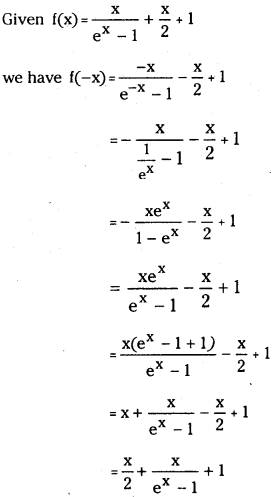
Question 2. Prove that the real valued function f(x) = x/ex−1 + x/2 + 1 is an even function on R – {0} –
Answer: f (x) ∈ R, ex – 1 ≠ 0 ⇒ ex ≠ 1 ⇒ x ≠ 0 Since f(-x) = f(x), the function f is even function on R – {0}.
Question 3. Find the domain and range of the following functions. (i) f(x) = tanπ[x]/1+sinπ[x]+[x2]
Answer: f(x) = tanπ[x]/1+sinπ[x]+[x2] ∈ R ⇔ x ∈ R; since [x] is an integar so that tan π [x] and sin π [x] are zero. ∀ x ∈ R Domain of f is R and Range = {0} (ii) f(x) = x/2−3x Answer: f(x) = x/2−3x ∈ R ⇔ 2 – 3x ≠ 0 ⇒ x ≠ 2/3 ∴ Domain of f = R – {2/3} Let y = f(x) = x/2−3x ⇒ 2y – 3xy = x ⇒ 2y = x(1 + 3y) ⇒ x = 2y/1+3y ∴ x ∈ R – {2/3}, 1 + 3y ≠ 0 ⇒ y ≠ −1/3 ∴ Range of f = R – {−1/3} (iii) f(x) = |x| + |1 + x| Answer: f(x) ∈ R ⇔ x ∈ R Domain of f = R ∴ |x| = x if x > 0 = – x if x < 0 |1 + x| = 1 + x if 1 + x > 0 ie., x > -1 = – (1 + x) if 1 + x < 0 ie., x < – 1 For x = 0, f(0) = 1, x= 1, f(1) = |1| + |1 + 1| = 3 x = 2, f(2) = |2| + |1 + 2| = 2 + 3 = 5 x = -2, f(-2) = |-2| + |1 +(-2)| = 2 + 1 = 3 x = -1, f(-1) = |-1| + |1 + (-1)| = 1
A set of three words are given. One or two letters which are common in all the three words are underlined. The underlined letter stands for one sound in two of the given words and for a different sound in the other word. The word with a different sound is to be written as the response.
The pronunciation of English words is quite tricky and confusing. Some vowels and consonants are pronounced differently in different places. Learning all these varieties is necessary to master pronunciation. It is possible only with practice.
Look at the following words. Circle the word that sounds different with regards to the sound of the bold letters.
Circle the words that sound different with regard to the sound of the bold letters.
Meaningful speech sounds are the basic raw material for any language. These sounds are represented by symbols in writing. We refer to these symbols as ‘alphabet’.
Most of the Indian languages have a fixed relationship between the sounds and their symbols. In other words, one symbol always stands for one sound and vice versa. Therefore we find absolutely no problem while reading or writing Indian languages once we learn the alphabet of that language.
The same is not the case with English. One letter may stand for many sounds. Example Q as / k / in car, as / s / in century as /t/ in change. One sound is also represented by various letters. Ex : / f / is represented by ‘ph’ in philosophy, by ‘f in fan, by ‘gh’ in rough. This results in a lot of problems for the learners, particularly for foreign learners in writing the spelling and pronouncing the written words.
A way out of this problem is a set of forty four symbols, called phonetic symbols. Each of these symbols stands for one sourid only. Learning these symbols arms us with the necessary weapons to war against the problems in pronounciation and spelling.
Study the following forty four phonetic symbols carefully and learn to identify and use them. Phonetic symbols are always placed between two Slant lines.
Vowels
Consonants
Writing the symbols that represent the sounds in a word is called phonetic transcript. In many examinations phonetic transcription is given and the examinee is asked to write the spelling of those words.
Exercises
Exercise – A
Read the words and fill in the spaces with the appropriate vowel symbol. The first one is done for you. If necessary, don’t hesitate to use a dictionary.
Exercise – B
Read the words according to the vowel symbols mentioned.
/ɪ/
/i:/
/u/
/u:/
/ɒ/
/ɔ:/
bit
beat
wood
wooed
pot
port
fit
feet
look
fluke
wad
ward
rich
reach
should
shoed
cod
cord
filled
field
soot
suit
don
dawn
Exercise – C
Go through the words and identify the sounds the end with. The first one is done for you.
Word
/t/ /d/ /id/
Word
/s/ /z/ /iz/
rounded
/id/
rounds
/z/
packed
/t/
packs
/s/
wished
/t/
wishes
/iz/
matched
/t/
matches
/iz/
flogged
/d/
flogs
/z/
played
/d/
plays
/z/
planted
/id/
plants
/s/
worked
/t/
works
/s/
Exercise-D
Read the following words. You will notice that in some words the letters ‘th’ are pronounced as /θ/ and in some others, as /ð/ and in some others, as 161. Write the sound you noticed. The first one is done for you. the /ð/ this /ð/ through /θ/ then /ð/ thus /ð/ thought /θ/ thick /θ/ mother /ð/
Exercise – E
We get confused with the sounds /w/ and /v/. The sound /w/ is pronounced with rounded lips. The sound /v/ is pronounced with the articulation of front upper teeth and lower lip and with more force. Now, pronounce the words aloud. wheel ventilator worst verse wet veto
Exercise – F
Read the following transcriptions and write the words in ordinary spelling. The first one is done for you.
Exercise – G
Pronounce the following words and transcribe them in the column my transcription Later, consult a dictionary and make necessary corrections.
Exercise – H
Words with short vowels are entirely different from their long counterparts. Understanding the difference is vital for pronunciation. Read the words in the following table and write a few more words from your text.
/ɪ/
/i:/
/ɪ/
/i:/
/ɪ/
/i:/ ‘
/ɪ/
/i:/
knit
neat
hid
heed
rim
ream
bid
bead
kill
keel
rid
read
lid
lead
din
dean
sit
seat
kin
keen
bin
bean/been
fill
feel
grit
greet
hit
heat
grid
greed
chit
cheat
Write the following transcriptions using ordinary English spelling.
Silent letters are a peculiar feature of English spelling. Letters are used in writing but the corresponding sounds are not uttered in pronunciation. This poses problems to learners both in spelling and pronunciation. A study says that 60% of the English words have silent letters !
Careful observation of both the spelling and pronunciation is the only way out to overcome this problem. There are, however, some generalizations about silent letters that will help learners understand this feature to some extent.
In the Intermediate Public Examination, normally, the words that appear in the prescribed selections with a silent consonant letter are set under this question.
Some Guidelines :
‘b’ before word final ‘t’ is silent – doubt debt.
‘b’ in final ‘mb’ clusters is also silent. comb womb tomb
‘g’ before word final ‘n’ is silent. sign resign foreign campaign reign sovereign
‘g’ in most ‘ough’, ‘augh’ combinations is silent. (But in some words with ‘augh’ it may sound as /f/ as in ‘laughter), though taught through benign thorough
‘h’ in word beginning position (not always) is silent. honest honour
‘k’ in word beginning followed by ‘n’ is silent. knowledge know knit knee knave knuckle
‘l’ before word final’m’ is silent. calm palm (but in realm and film – T is not silent)
Word final ‘n’ preceded by ‘m’ is silent, condemn column autumn
‘p’ in word beginning position followed by ‘s’ is silent. ’psychology psalm pseudo
‘p’ in words like receipt is also silent.
‘r’ followed by a consonant letter is silent, world card
‘f is silent in clusters like ‘astle’, ‘isten’, ‘istle’ as in castle whistle listen
‘W’ is silent in words like Write wrap know fawn lawn
(These guiding principles are by no way exhaustive. They help the learner to a great extent in identifying the silent letters. About vowels – the problem is not this simple or unambiguous. So no generalisation is given here.)
TEXTUAL EXAMPLES
Silent letter – Example words
b – lamb, bomb, tomb, climb, dumb, subtle, plumber, womb, crumb, thumb c – muscle, blackguard, yacht, indict, scene d – Wednesday, handkerchief, handbag, handsome, adjourn, adjective, judge g – gnaw, gnome, phlegm, foreign, resign, campaign, align, sovereign h – honour, heir, ghost, night, rhyme, rhythm, when, where, hour k – know, knee, knock, knot, kneel, knowledge t – talk, folk, salmon, colonel, calf, calm, half, walk, baulk m – mnemonic . . . n – hymn, solemn, damn, autumn, column p – recepit, psychic, pneumonia, psyche q(u) – lacquer r – girl, bird, card, teacher, leader, curd, world s – isle, aisle, viscount, island t – thistle, fasten, mortgage, soften, watch, tsunami w – whole, sword, two, who, wrist, wrong y – prayer, mayor z – rendezvous gh – sigh, high, daughter, naughty, caught, brought, bought, night, haughty
Exercise -1
QuestionI.
Underline the silent letters in the following words?
i) bright – gh ii) scene – c iii) hour – h – r iv) neighbour – g, h, r v) wrong – w vi) knell – k vii) wreath – w viii) palm – l ix) limb – b x) design – g
Exercise – 2
i) chalk ii) knock iii) depot iv) teacher v) often vi) thought vii) honest viii) almond ix) know x) talk
Answer:
i) chalk – 1 ii) knock – k iii) depot – t iv) teacher – r v) often – t vi) thought – gh vii) honest – h viii) almond – l ix) know – k, w x) talk – l
i) thorough – gh ii) who – w iii) benign – g iv) receipt – p v) rhythm – h vi) diversity – r vii) nursery – r viii) column – n ix) curd – r x) kneel – k
Exercise – 6
i) bustle ii) although iii) parliament iv) fight v) knee vi) brought vii) bomb viii) could ix) hymn x) which
Answers:
i) bustle – t ii) although – gh iii) parliament – r, i iv) fight – gh v) knee – k vi) brought – gh vii) bomb – b viii) could – l ix) hymn – n x) which – h
i) align – g ii) ghost – h iii) leader – r iv) straight – gh v) calf – l vi) plumber – b, r vii) wrap – w viii) thistle – t ix) attempt – t x) burden – r
Exercise – 8
i) through ii) sovereign iii) slightly iv) tsunami v) watch vi) tomb vii) caught viii) naughty ix) half x) leopard
Answer:
i) through – gh ii) sovereign – g iii) slightly – gh iv) tsunami – t v) watch – t vi) tomb – b vii) caught – gh viii) naughty – gh ix) half – l x) leopard – o, r
Exercise – 9
i) wrist ii) daughter iii) receipt iv) solemn v) hatter vi) mnemonic vii) 4umb viii) damn ix) should x) folk
Answer:
i) wrist – w ii) daughter – gh iii) receipt – p iv) solemn – n v) hatter – r vi) mnemonic – m vii) dumb – b viii) damn – n ix) should – l x) folk – l
i) knock – k ii) autumn – n iii) cupboard – p iv) tight – gh v) walk – l vi) sword – w, r vii) subtle – b viii) psalm – p, l ix) handsome – d x) gnaw – g, w
The Telangana State Board of Intermediate Education (TSBIE) plays a vital role in shaping the academic foundation of students pursuing Intermediate education in Telangana. Students appearing for TS Inter 2nd Year (Intermediate II Year) examinations often search for textbook solutions PDFs to strengthen their preparation. To meet this demand, Manabadi.co.in provides easy access to TS Inter 2nd Year textbook solutions PDF downloads for all major subjects.
In this article, we will cover everything you need to know about TS Inter 2nd Year books, subject-wise solutions, benefits of using solutions PDFs, download steps, and exam preparation tips.
Subjects Covered in TS Inter 2nd Year Textbook Solutions
TS Inter provides solutions for all major Intermediate subjects, including Mathematics, Physics, Chemistry, Biology, Economics, Commerce, Accountancy, History, Political Science, and Languages. Both Telugu and English medium students can access subject-wise solutions according to their curriculum needs.
Subject Name
Solutions
Mathematics
Mathematics Inter 2nd Year Textbook Solutions
Physics
Physics Inter 2nd Year Textbook Solutions
Chemistry
Chemistry Inter 2nd Year Textbook Solutions
Biology
Biology Inter 2nd Year Textbook Solutions
Economics
Economics Inter 2nd Year Textbook Solutions
Commerce
Commerce Inter 2nd Year Textbook Solutions
Accountancy
Accountancy Inter 2nd Year Textbook Solutions
History
History Inter 2nd Year Textbook Solutions
Political Science
Political Science Inter 2nd Year Textbook Solutions
English
English Inter 2nd Year Textbook Solutions
About TS Inter 2nd Year (Intermediate II Year)
TS Inter 2nd Year is the final stage of Intermediate education in Telangana. It is a crucial academic year as students’ results influence admissions into professional courses like Engineering, Medicine, Degree, Pharmacy, Agriculture, and other higher education programs.
The syllabus is prescribed by TSBIE, and textbooks are designed to build conceptual clarity, problem-solving ability, and exam-oriented understanding.
TS Inter 2nd Year Textbook Solutions PDF at Manabadi.co.in
Manabadi.co.in is one of the most trusted educational portals in Telangana and Andhra Pradesh. It offers free and easy access to TS Inter 2nd Year study materials, including:
Subject-wise textbook solutions
Chapter-wise PDFs
Updated syllabus-based content
Exam preparation resources
All solutions available on Manabadi are prepared by subject experts following the latest TSBIE syllabus.
Subjects Covered – TS Inter 2nd Year Solutions PDF
1. TS Inter 2nd Year Mathematics Solutions
Mathematics IIA
Mathematics IIB Includes:
Algebra
Calculus
Vectors
Probability
Integral Calculus
Step-by-step solutions help students understand complex problems clearly.
2. TS Inter 2nd Year Physics Solutions
Covers:
Electrostatics
Current Electricity
Magnetism
Optics
Modern Physics
Physics solutions explain derivations, numerical problems, and theory-based questions in a simple manner.
3. TS Inter 2nd Year Chemistry Solutions
Includes:
Physical Chemistry
Organic Chemistry
Inorganic Chemistry
Detailed explanations of reactions, equations, and conceptual topics are provided.
4. TS Inter 2nd Year Biology Solutions
Covers:
Botany
Zoology
These solutions are useful for medical aspirants preparing for NEET along with board exams.
5. TS Inter 2nd Year English Solutions
Includes:
Prose
Poetry
Supplementary Readers
Grammar exercises
English solutions help students improve writing skills and exam presentation.
6. TS Inter 2nd Year Commerce Solutions
Accountancy
Economics
Business Studies
Well-structured answers make it easier for commerce students to score high marks.
7. TS Inter 2nd Year Humanities & Vocational Subjects
History
Civics
Sociology
Psychology
Vocational course subjects
These solutions focus on clarity, definitions, and exam-oriented answers.
How to Download TS Inter 2nd Year Textbook Solutions PDF from Manabadi.co.in
Follow these simple steps to download PDFs:
Visit the official website manabadi.co.in
Search for “TS Inter 2nd Year Textbook Solutions”
Select your subject and chapter
Click on PDF Download
Save the file to your device for offline study
All PDFs are student-friendly and printable.
Benefits of Using TS Inter 2nd Year Solutions PDFs
Free Access Students can download solutions without any cost. Chapter-wise Learning Each chapter is explained separately for easy understanding. Board Exam Oriented Answers are prepared according to TSBIE exam pattern. Time-Saving Quick revision becomes easy before exams. Concept Clarity Helps students strengthen weak areas.
TS Inter 2nd Year Exam Preparation Tips
Here are some effective tips to score high marks:
Study textbooks thoroughly before referring to solutions
Practice numerical problems daily
Revise important derivations and formulas
Solve previous year question papers
Maintain short notes for quick revision
Use Manabadi solutions for self-evaluation
Frequently Asked Questions (FAQs)
Q1. Are TS Inter 2nd Year textbook solutions free on Manabadi? Yes, all solutions PDFs are available for free. Q2. Are these solutions based on the latest syllabus? Yes, they strictly follow the latest TSBIE syllabus. Q3. Can I download PDFs on mobile? Yes, PDFs are mobile and tablet-friendly. Q4. Do these solutions help for competitive exams? Yes, especially for Physics, Chemistry, Maths, and Biology.
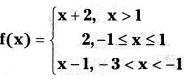
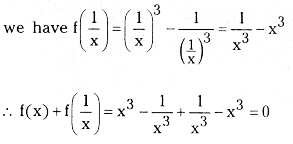
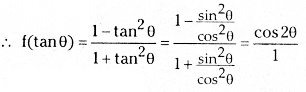
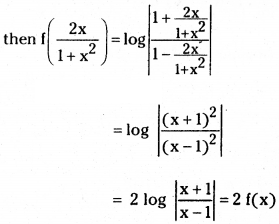
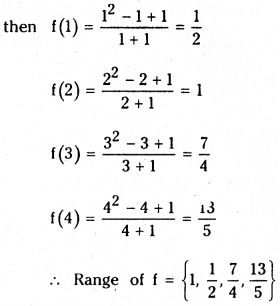
TS Inter 1st Year Maths 1A Functions Solutions Exercise 1(a) I. Question 1. If the function f is defined by then find the values of (i) f(3) (ii) f(0) (iii) f(-1.5) (iv) f(2) + f(- 2) (v) f(- 5) Answer: (i) f(3), For x > 1; f(x) = x + 2 f(3) = 3 + 2 = 5 (ii) f(0), For – 1 ≤ x ≤ 1; f(0) = 2 (iii) f(-1.5), For – 3 < x < – 1; f(x) = x – 1 ∴ f(-1.5) = -1.5- 1 = – 2.5 (iv) f(2) + f(-2); For x > 1, f(x) = x + 2 ∴ f(2) = 2 + 2 = 4 For – 3 < x < – 1; f(x) = x – 1 f(-2) = -2 – 1 = -3 f(2) + f (-2) = 4 – 3 = 1 (v) f(-5); is not defined such domain of ‘f’ is {x / x > – 3]. Question 2. If f : R {0} → R defined by f(x) = x3 – 1/x3, then show that f(x) + f(1/x) = 0. Answer: Given f(x) = x3 – 1/x3 Question 3. If f: R → R defined by f(x) = 1−x2/1+x2, then show that f(tan θ) = cos 2θ Answer: Given f(x) = 1−x2/1+x2 ∀ x ∈ R = cos 2θ Question 4. If f: R – (±1) → R is defined by f(x) = log∣1+x/1−x∣, then show that f(2x/1+x2) = 2f(x). Answer: Given f: R – (±1) → R defined by f(x) = log∣1+x/1−x∣ Question 5. If A = (-2, -1, 0, 1, 2) and f : A → B is a surjection defined by f(x) = x2 + x + 1, then find B. (May 2014) Answer: A = {-2,-1,0,1,2} and f: A → B is a surjection and f(x) = x2 + x + 1; ∴ f(-2) = (-2)2 + (-2) + 1=3, f(-1) = (-1)2 + (-1) + 1 = 1 f(0) = 02 + 0 + 1 = 1 f(1) =12 + 1 + 1 = 3 f(2) = 22 + 2 + 1 = 7 ∴ B = f(A) = (1, 3, 7) Question 6. If A = {1, 2, 3, 4} and f: A → R is a function defined by f(x) = x2−x+1/x+1, then find the range of f. Answer: Given A = {1, 2, 3, 4} and f(x) = x2−x+1/x+1 Question 7. If f (x + y) = f (xy) ∀ x, y ∈ R, then prove that f is a constant function. Answer: Given f (x + y) = f(x y) ∀ x, y ∈ R Suppose x = y = 0 then f(0 + 0) = f(0 x 0) ⇒ f(0) = f(0) ………………..(1) Suppose x = 1, y = 0 then then f (1 + 0) = f(1 x 0) ⇒ f(D = f (0) ……………(2) Suppose x = 1, y = 1 then f (1 + 1) = f(1 x 1) ⇒ f(2) = f(1) …………….. (3) f(0) = f(1) = f(2) = f(0) = f(2) Similarly f(3) = f(0), f(4) = f(0) …………. f(n) = f(0) ∴ f is a constant function.
II. Question 1. If A = {x / – 1 ≤ x ≤ 11, f(x) = x2, g(x) = x3 Which of the following are surjections (i) f : A → A (ii) g : A → A. Answer: i) Given A {x / – 1 ≤ x ≤ 1}, f(x) = x2 and f : A → A Suppose y ∈ A then x2 = y ⇒ x = ± √y If x = √y and if y = – 1 then x = √-1 ∈ A f : A → A is not a surjection. ii) Given A = {x/-1 ≤ x ≤ 1), g(x) = x3 and g : A → A Suppose ye A then x2 = y ⇒ x = y√3 ∈ A If y = -1 then x = -1 ∈ A y = 0 then x = 0 ∈ A y = 1 then x = 1 ∈ A g : A → A is a surjection. Question 2. Which of the following are injections or surjections or Bisections ? Justify your answers. i) f : R → R defined by f(x) = 2x+1/3 Answer: Given f(x) = 2x+1/3 Let a1, a2 ∈ R ∴ f(a1) = f(a2) ⇒ 2a1+1/3=2a2+1/3 ⇒ 2a1 + 1 = 2a2 + 1 ⇒ a1 = a2 f(a1) = f(a2) ⇒ a1 = a2 ∀ a1, a2 ∈ R f(x) = 2x+1/3 is an injection.
Suppose y ∈ R (codomain of f) then y = 2x+1/3 ⇒ x = 3y−1/2 Then f(x) = f(3y−1/2)=2(3y−1)/2+1/3 = y f is a surjection f: R → R defined by f(x) = 2x+1/3 is a bijection.
ii) f : R → (0, ∞) defined by f(x) = 2x Answer: Let a1, a2 ∈ R then f(a1) = f(a2) ⇒ 2a1 = 2a2 ⇒ a1 = a2 ∀ a1, a2 ∈ R f(x) = 2x, f: R → (0, ∞) is injection. Let y ∈ (0, ∞) and y = 2x ⇒ x = log2 y then f(x) = 2x = 2 log2y = y ∴ f is a surjection. Since f is injection and surjection, f is a bijection. iii) f : (0, ∞) → R defined by f(x) = logex. Answer: Let x1, x2 ∈ (0, ∞)and = logex. then f(x1) = f(x2) ⇒ logex1 = logex2 ⇒ x1 = x2 ∴ f(x1) = f(x2) x1 = x2 and f is injection.
Let y ∈ R then y = logex ⇒ x = ey f(x) = logex = logeey = y and f is a surjection. Since f is both injective and surjective, f is a bijection.
iv) f : [0, ∞) → [0, ∞) defined by f(x) = x2 Answer: Let x1, x1 ∈ [0, ∞) given f(x) = x2 f(x1) = f(x2) ⇒ x1 = x2 x1 = x2 (∵ x1, x2 > 0) f(x) = x2, ∴ f: [0, ∞) → [0, ∞) is an injection.
Let y ∈ [0, ∞)then y = x2 ⇒ x = √y (∵ y > 0) f(x) = x2 = (√y)2 = y and f is a surjection ∴ f is a bijection.
v) f : R → [0, ∞) defined by f(x) = x2 Answer: Let x1 x2 ∈ R and f(x) = x2 ∴ f(x1) = f(x2) ⇒ x12 = x22 ⇒ x1 = ±x2 (∵ x1, x2 ∈ R) f is not an injection Let y ∈ [0, ∞] then y = x2 ⇒ x = ±√y where y ∈ [0, ∞] then f(x) = x2 = (√y )2 = y. ∴ f is a surjection. Since f is not injective and only surjective, we say that f is not a bijection.
vi) f : R → R defined by f(x) = x2 Answer: Let x1 x2 ∈ R then f(x1) = f(x2) ⇒ x12 = x22 ⇒ x1 = ± x2 (∵ x1, x2 ∈ R) f(x) is not an injection. Let y ∈ R then y = x2 ⇒ x = ±√y For elements that belong to (-∞, 0). codomain R of f has no pre-image in f. ∴ f is not a surjection. Hence f is not a bijection.
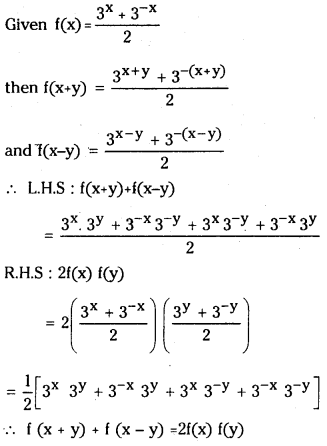
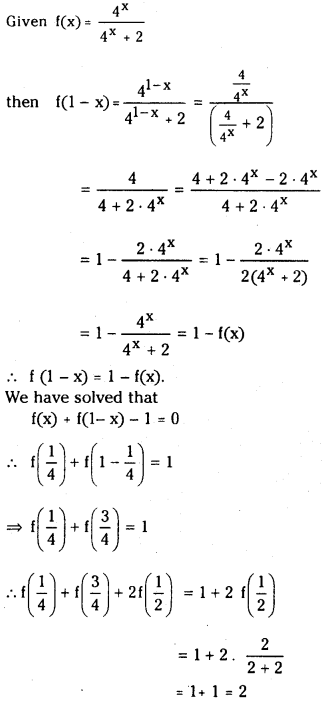
Question 3. If g = 1(1,1), (2, 3), (3, 5), (4, 7)) is a function from A = {1, 2, 3, 4} to B = {1, 3, 5, 7}. If this is given by the formula g(x) = ax + b then find a and b. Answer: A = {1, 2, 3, 4}, B = {1, 3, 5, 7} g = {(1, 1), (2, 3), (3, 5), (4, 7)} ∵ g(1) = 1, g(2) = 3, g(3) = 5, g(4) = 7 Hence for an element a ∈ A f ∃ b ∈ B such that g : A → B is a function. Given g(x) = ax + b ∀ x ∈ A g(1) = a + b = 1 g(2) = 2a + b = 3 solving a = 2, b = -1 Question 4. If the function f : R → R defined by f(x) = 3x+3−x/2, then show that f (x+y) + f (x-y) = 2 f(x) f(y). Answer: Question 5. If the function f : R → R defined by f(x) = 4x/4x+2, then show that f (1 – x) = 1 – f(x) and hence reduce the value of f(14) + 2f(12) + f(34). Answer: Question 6. If the function f : {-1, 1} → {0, 2} defined by f(x) = ax + b is a subjection, then find a and b. Answer: Since f: {-1, 1} → {0, 2} and f(x) = ax + b is a surjection. Given f (-1) = 0, f (1) = 2 (or) f (-1) = 2, f (1)=0 Case I : f (-1) = 0, f (1) = 2 ∴ – a + b = 0, a + b = 2 Solving b =1 , a = 1
Case II : f (-1) = 2, and f (1) = 0 then – a + b = 2 and a + b = 0 Solving b = 1, a = -1 Hence a = + 1 and b = 1 Question 7. If f(x) = cos (log x), then show that f(1/x) f(1/y) – (1/2)[f(x/y) + f(x/y)] = 0 Answer: Given f(x) = cos(log x) then f(1/x) = cos(log(1/x)) = cos(-log x) = cos(log x) (∵ log 1 = 0) Similarly f(1/x) = cos(log y) f(x/y) = cos(log(xy)) = cos(log x – log y) f(x/y) = cos (log xy) = cos [log x + log y] f(x/y) + f(x y) = cos(log x – log y) + cos (log x + log y) = 2 cos (log x) cos (log y) (∵ cos (A – B) + cos (A + B)) = 2 cos A cos B f(1/x) f(1/y) – (1/2)[f(x/y) + f(x/y)] = cos (log x) cos (log y) – 1/2 [2cos (log x) cos (logy)] = 0
TS Inter 1st Year Maths 1A Functions Solutions Exercise 1(b)
I.
Question 1. If f(x) = ex, and g(x) = logex, then show that fog = gof and find f-1 and g-1.
Answer: Given f(x) = ex and g(x) = logex Now (fog) (x) = f[g(x)] = f [logex] = elogex = x (gof) (x) = g [f(x)] = g [ex] = logeex = x fog = gof given f(x) = ex = y then x = f-1 (y) and y = ex ⇒ x = logey f-1(y) = logey ⇒ f-1 (x) = logex similarly y = g(x) = logex then x = g-1 (y) and y = logex ⇒ x = ey g-1 (y) = ey ⇒ g-1(x) = ex
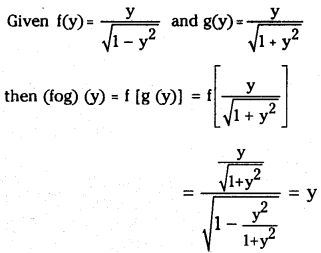
Question 2. If f(y) = y/√1−y2, g(y) = y/√1+y2 then show that (fog)(y) = y.
Answer: ∴ (fog) (y) = y
Question 3. If R → R; g : R → R are defined by . f(x) = 2x2 + 3 and g(x) = 3x – 2, then find (i) (fog) (x) (ii) (gof) (x) (iii) (fof)(0) (iv) go (fof) (3)
Answer: f; R → R; g : R → R and f(x) = 2x2 + 3, g(x) = 3x – 2 then (i) (fog) (x) = f [g (x)] = f (3x – 2) = 2 [(3x – 2)2] + 3 (∵ f (x) = 2x2 + 3) = 2 [9x2 – 12x + 4] + 3 = 18x2 – 24x + 11 (ii) (gof) (x) = g [f (x)] = g (2x2 + 3) = 3 (2x2 + 3) -2 = 6x2 + 7
iii) (fof) (0) = f [f (0)] = f [3] = 2(3)2 + 3 = 21
iv) go (fof) (3) = go [f (f (3))] (v f (x) = 2x2 + 3) = go [f (2(3)2 + 3)] = go [f (21)] = g [2 (21)2 + 3] = g [2 (441) + 3] = g [885] = 3 (885) – 2 = 2653 (∵ g(x) = 3x – 2)
Question 4. If f:R → R, g:R → R are defined by f(x) = 3x – 1, g(x) = x2 + 1, then find (i) (fof) (x2 + 1) (ii) (fog) (2) (March 2012) (iii) (gof)(2a – 3)
Answer: Given f: R → R and g : R → R defined by f (x) = 3x – 1, g (x) = x2 + 1 (i)(fof) (x2 + 1 ) = f [f (x2 + 1)] = f [3 (x2 + 1) – 1] ⇒ f [3x2 + 2] (∵ f (x) = 3x – 1) = 3 (3×2 + 2) – 1 = 9×2 + 5
(ii) (fog) (2) = f [g (2)] = f [22 + 1] = f [5] = 3(5) – 1 = 14
Question 7. If f(x) = 2, g(x) = x2, h(x) = 2x ∀ x ∈ R, then find [fo(goh) (x)].
Answer: fo(goh)= fog [h(x)] = fog [2x] = f [g(2x)] = f [ (2x)2 ] = f (4x2) = 2 ∴ fo(goh) = 2
Question 8. Find the inverse of the following functions. (i) a, b ∈ R, f: R → R, defined by f(x) = ax + b, (a ≠ 0).
Answer: a, b ∈ R, f : R → R and f(x) = ax + b ⇒ y = ax + b = f(x) ⇒ x = f-1(y) = y−b/a ∴ f-1(x) = x−b/a (ii) f: R → (0, ∞) defined by 5x (March 2011) Answer: f: R→ (0, ∞) and f(x) = 5x Let y = f (x) = 5x ⇒ x = f-1(y) and x = log5y ∴ f-1(y) = log5y ⇒ f-1(x) = log5x
(iii) f : (0, ∞) → R defined by f(x) = log2x Answer: Gii’en f: (0, ∞) → R defined by f(x) = log2x Let y = f (x) = log2x then x = f1 (y) y = log2x ⇒ x = 2y ∴ f-1(y) = 2y ⇒ f-1(x) = 2x
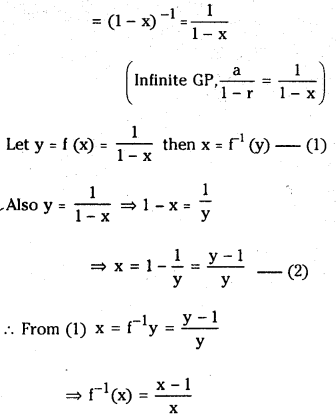
Question 9. If f(x) = 1 + x + x2 + ………….. for |x| < 1, then show that f-1(x) = x−1/x
Answer: Given f(x) = 1 + x + x2 + ………. for |x| < 1
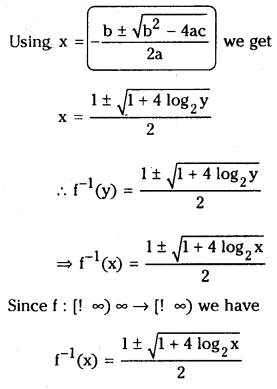
Question 10. If f : [1, ∞] → [1, ∞] defined by f(x) = 2x(x – 1), then find f-1(x)
Answer: Given f : [1, ∞] → [1, ∞] defined by f(x) = 2x(x – 1) Let y = f(x) then x = f-1(y) Also y = 2x(x – 1) ⇒ x(x – 1) = log2y ⇒ x2 – x – log2y = 0 II.
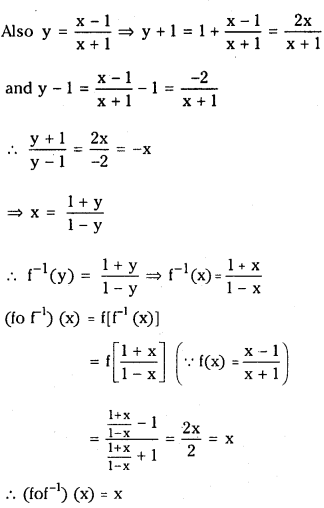
Question 1. If f(x) = x−1/x+1, x ≠ ±1, then verify (fof-1)(x) = x
Answer: Given f(x) = x−1/x+1, (x ≠ ±1) and Let y = f(x) ⇒ x = f-1(x)
Question 2. If A = (1, 2, 3), B = (α, β, γ), C = (p, q, r) and f : A → B, g : B → C are defined by f = {(1, α), (2, γ), (3, β)}, g = {(α, q), (β, r), (γ, p)} then show that f and g are bijective functions and (gof)-1 = f-1og-1.
Answer: Given A = {1, 2, 3}, B = (α, β, γ), c = {p, q, r) and f : A → B, g : B → C defined by f ={(1, α) (2, γ), (3, β)}and g = {(a, q), (β, r), (γ, p)} From the definitions of f and g f (1) = α, f (2) = γ, f (3) = β and g (α) = q, g (β) = r, g (γ) = p Distinct elements of A have distinct imagine in B. Hence f is an Injection. Also, range of f = (a, y, P) and f is a surjection. ∴ f is abijection = B similarly distinct elements of B have distinct images in c and g is an Injection. Also range of ‘g’ = {q, γ, p} = C; ∴ g is a surjection. Hence g is a bijection. ∴ f and g are bijective functions. Also gof = {(1, q), (2, r), (3, p)} and (gof-1) = {(q, 1), (r, 2), (p, 3)} …………….(1) f-1 = {(α, 1), (γ, 2), (β, 3)} and g-1 = {(q, α), (r, β), (p, γ)} ∴ f-1og-1 ={(q, 1), (r, 2), (p, 3)} ………………(2) ∴ From (1) and (2), (gof-1) = f-1og-1
Question 3. If f:R → R; g:R → R defined by f(x) = 3x – 2, g(x) = x2 + 1, then find (i) (gof-1) (2) (ii)(gof)(x – 1) (March 2008, May 2006)
Answer: Given f: R → R, g : R → R defined by f(x) = 3x – 2, g(x) = x2 + 1 et y = f (x) then x = f-1 (y) y = 3x – 2 ⇒ 3x = y + 2 ⇒ x = y+2/3 ∴ f-1(y) = 3+2/3 ⇒ f-1(x) = x+2/3 ∴ (i)(gof-1) (2) = g[f-1(2)] = g[4/3] = (4/3)2 + 1 = 16/9 + 1 = 25/9 (ii)(gof) (x – 1) = g [f (x – 1) = g [3 (x – 1) – 2] = g [3x – 5] = (3x – 5)2 + 1 = 9x2 – 30x + 26 (∵ g(x) = x2 + 1)
Question 4. Let f = {(1, a), (2, c), (4, d), (3, b)} and g-1 = {(2, a) (4, b), (1, c), (3, d)} then show that (gof)-1 = f-1o g-1
Question 5. Let f:R → R; g:R → R be defined by f(x) = 2x – 3, g(x) = x3 + 5 then find (fog)-1(x)
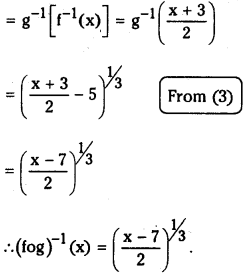
Answer: We have from the formula (fog)-1(x) = (g-1of-1) …………..(1) where f: R → R and g : R → R are defined by f(x) = 2x – 3 and g(x) = x3 + 5 Let y = f(x) = 2x – 3 : Then x = f-1(y) and 2x – 3 = y ⇒ x = y+3/2 f-1(x)x+3/2 ………..(2)
Let y = g(x) = x3 + 5. Then x = g-1(y) and x3 + 5 = y ⇒ x = (y – 5)1/3 g-1(y) = (y – 5)1/3 g-1(x) = (x – 5)1/3 ……….(3)
From (1), (g-1of-1)(x)
Question 6. Let f(x) = x2,g(z) = 2x. Then solve the equation (fog) (x) = (gof) (x)
Answer: Given f(x) = x2 and g(x) = 2x (fog) (x) = f [g(x)] = f [2x] = (2x)2 = 22x ……………(1) and (gof)(x) = g[f(x)] = g[x2] = 2x2 ∴ from (1) and (2), 22x = 2x2 ⇒ x2 – 2x = 0 ⇒ x(x – 2) =0 ⇒ x = 0, 2
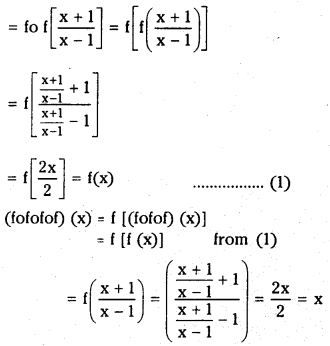
Question 7. If f(x) = x+1/x−1,(x ≠ ±1),then find(fofof)(x) and (fofofof) (z)
Answer: Given f(x) = x+1/x−1, (x ≠ ± 1) then (fofof) (x) = fof(f(x)]